Moving house with pets in Queensland goes smoothly when the animals are out of the way on the day, travelling with you rather than with the furniture, and legally sorted at the new address within the first fortnight. Dogs and cats get stressed by open doors, strangers and a house that suddenly smells wrong, so most of the work happens before the truck turns up. Here is the order we suggest, from the week before through to the first night in the new place, plus the registration and microchip steps Queensland councils expect.
Key takeaways
Pets should be shut in a quiet room, with a sign on the door, or minded somewhere else while a removal crew is working, because front doors and gates stay open for hours. Dogs and cats travel in the family car, restrained or in a carrier, never left in a parked vehicle in Queensland heat. In Queensland, a dog must be registered with the new council within 14 days of moving into a new local council area, and microchip registry details must be updated within 7 days of a change. Cat registration rules vary between councils, so check with the new council before moving day.
Why is moving day so hard on dogs and cats?
From a pet's point of view, a move is a day of chaos. Furniture disappears, strangers walk in and out carrying things, and the doors that are normally shut stay wide open. Our crews see it often: a nervous dog barking at every trip to the truck, or a cat slipping out the side gate behind a couch.
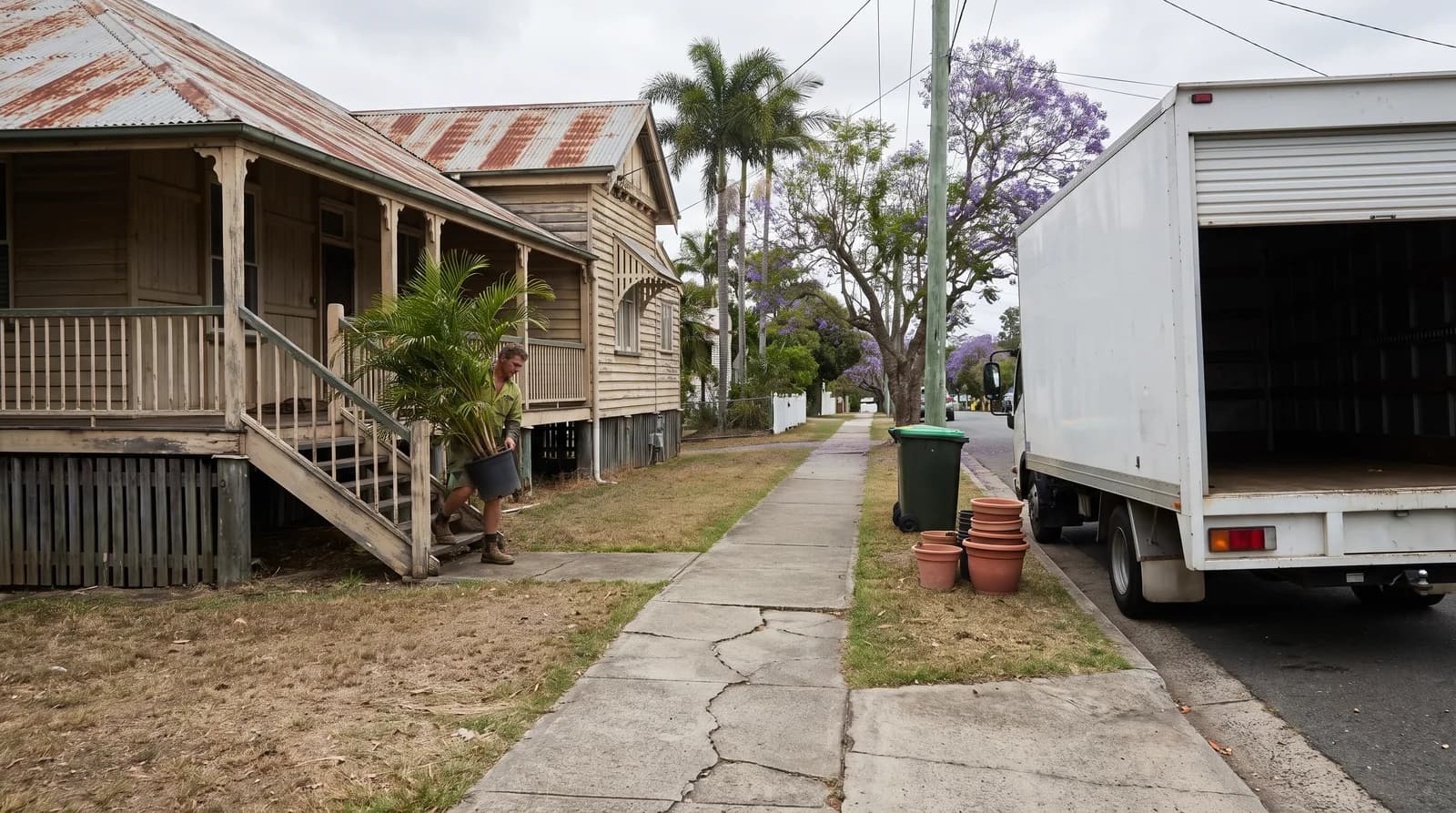
The open door is the real risk. On a typical three-bedroom house move in Carindale or Chermside, the front door and the side gate are open from the moment the crew arrives until the last carton goes on the truck. A highset Queenslander with an open stairwell and a gap under the deck gives a frightened cat plenty of places to hide, and a dog only needs a second to bolt onto a busy street.
What should you do with pets the week before the move?
Start packing a little at a time rather than in one big weekend. A house that slowly fills with cartons is easier for an animal to accept than one that changes overnight. Leave the pet's bed and blankets until last, unwashed, because the familiar smell settles them at the other end.
If your cat or dog has never spent time in a carrier, put the carrier out in the lounge room now, door open, with a towel and a few treats inside. A cat that has slept in its carrier for a week goes in far more easily on moving morning than one that only sees it on vet days. This is also the week to book a kennel, a cattery or a friend for the day if you plan to send the pets away. If your animal is elderly, unwell or badly anxious in the car, talk to your vet about the trip.
Pack a pet bag
Put food for three or four days, the bowls, a water bottle, the lead, the litter tray and litter, any medication, a favourite toy and some old towels into one bag or tub, and keep it in the car rather than on the truck. When the cartons arrive at the new house, you will not want to be hunting through them for the cat food at 9pm.
Where should pets be while removalists are loading?
Ideally, not at the house at all. A day with a friend, at doggy day care or in a boarding kennel takes the pet out of the noise completely. If that is not practical, a quiet room works well.
Choose a room the crew can finish first or leave until last, usually a bathroom, laundry or spare bedroom. Empty it, put the pet in with water, a bed and a litter tray, shut the door and stick a sign on it saying the animal is inside. Tell the crew leader when they arrive. Our Brisbane crews will happily work around a closed door, but they need to know it is there and why. Yards are less reliable than rooms, because side gates get propped open for a trolley run to the truck.
“The most common pet problem we see on moving day is not an aggressive dog. It is a gate someone propped open for the trolley, and a cat nobody can find when it is time to leave. A closed door with a sign on it solves almost all of it.”
, R2G Moving Team
How should you transport pets to the new home?
Pets travel with you in the family car, not in the back of a removal truck. The cargo area of a truck is dark, has no air conditioning, and carries heavy furniture that can shift on a corner. Cats travel best in a secure carrier on the back seat, ideally belted in. Dogs travel best in a crate or with a harness clipped to a seatbelt point.
There are legal rules too. Under Queensland's road rules, the Queensland Government's road rules guide notes that it is an offence to drive with an animal in your lap, and it recommends animals travelling inside a vehicle are restrained. Under the Animal Care and Protection Act 2001, Business Queensland's guide to transporting dogs sets out that a dog inside a vehicle must not be able to stick out of it beyond its head, and a dog on a ute tray or trailer must be secured so it cannot fall off, move off or be injured by the vehicle's movement.
Heat is the other danger, and Queensland summers make it serious. RSPCA Queensland warns that a parked car can get dangerously hot even with the windows down in a shaded spot, and in one of its own tests a light-coloured sedan reached 57 degrees inside within 12 minutes on a 30 degree day. On a move, never leave the dog in the car while you check the new house. Take the pets straight inside, or have someone stay with them in the shade with water.

Do you need to register your dog with a new council in Queensland?
Yes, if you are moving into a different council area. The Queensland Government's laws for pet owners say all dogs must be registered with the local council within 14 days after moving to a new local council area. Registration does not carry over between councils. The Cairns Regional Council dog registration FAQs are clear that there are no reciprocal arrangements, so a dog moving to Cairns from Townsville or Brisbane is registered fresh, and the owner should let the old council know the dog has left its area.
Moving within the same council area is simpler, but there is still paperwork. Brisbane City Council asks owners to update their dog's registration details within 14 days of a move, and Cairns Regional Council asks for changes within 7 days for a move inside the region. Regulated dogs, meaning dogs declared dangerous or menacing, carry stricter rules, including telling both councils within 7 days when the new address is in a different council area. If that applies to you, read the Queensland Government's regulated dog page before you sign a lease.
Cats are different. The state guidance says to contact your local council to find out whether cats must be registered in your area, because the rules vary. Some councils also limit how many animals you can keep without a permit, and Cairns Regional Council's registration form ties that number to block size. Check before you move from a big block to a unit or small lot.
How do you update your pet's microchip details?
Microchipping is mandatory in Queensland, and the council does not update the microchip for you. Under section 16 of the Animal Management (Cats and Dogs) Act 2008, an owner must notify the microchip registry of changed information within 7 days. Brisbane City Council reminds owners that it does not update microchip details when you change your registration address.
If you do not know which registry holds your pet's chip, several Queensland councils, including Logan City Council, point owners to the Pet Address website, where you enter the 15-digit microchip number and it tells you which registry to contact. Do it before the move. If the dog gets out on day two, the chip only helps if the phone number on it is current. Put the microchip update on the same list as your other address changes in our change of address checklist.
How do you settle a pet into a new house?
Set up one room for the pet before you unpack anything else. Put down the bed, bowls, litter tray and a couple of worn T-shirts or blankets that smell like home, then let the animal spend the first night or two in that room while the rest of the house fills up with cartons. Cats in particular do better exploring a new place one room at a time.
Walk the yard before the dog goes out in it. Look for gaps under the fence, a loose gate latch, a pool fence that does not close on its own, and anything left behind by the previous owners, such as rat bait in the shed. In older Brisbane suburbs like Ashgrove or Coorparoo, the space under a highset house is a common escape route and hiding spot, so check the lattice. Up in Cairns, around Edge Hill or Trinity Beach, give a dog shade and plenty of water in the yard from day one, because the humidity takes some getting used to. Keep cats indoors for the first couple of weeks, keep dogs on the lead until they know the street, and feed them at the usual times.
What about fish tanks, birds and other pets?
Animal enclosures and fish tanks are specialist items for any removalist, and R2G's terms ask customers to let us know about them when booking. A full aquarium cannot be moved safely, so the usual approach is to bag the fish with some of their own tank water, drain the tank, and move the tank empty and padded with the filter media kept damp. Birds and small animals such as guinea pigs, rabbits and reptiles travel with you in the car in their cage or a carrier, covered and out of direct sun.
Moving pets across a state border can add biosecurity or entry rules, so check them well ahead of an interstate move. The same idea applies to plants, which we cover in our guide to moving plants interstate to Queensland. For the bigger picture of the day itself, the ultimate moving day checklist runs through the rest of the timeline.
Frequently Asked Questions
Can removalists move my pets in the truck?
No, pets should never travel in the back of a removal truck. The cargo area is enclosed, has no air conditioning and carries heavy furniture that can move on corners, which is a serious welfare risk in Queensland heat. Dogs and cats travel with you in the car, in a carrier or crate or restrained with a harness. Tell your removalist about any animals at the property when you book.
How long do I have to register my dog after moving in Queensland?
Queensland Government guidance says dogs must be registered with the local council within 14 days of moving to a new local council area. Registration does not transfer between councils, so you register again with the new one and tell the old council the dog has left. If you move within the same council area, update your address with the council inside its stated timeframe.
Should I keep my cat inside after moving house?
Yes, we suggest keeping a cat inside for at least the first couple of weeks after a move. Start the cat in one quiet room with its bed, litter tray and familiar bedding, then open up the rest of the house gradually. Letting a cat outside too early is when many go missing, often trying to find their way back to the old address.
Do I need to update my pet's microchip when I move?
Yes. Under Queensland's Animal Management (Cats and Dogs) Act 2008, owners must tell the microchip registry about changed details within 7 days. Your council does not do this for you when you update your registration. If you are unsure which registry holds the chip, the Pet Address website will look it up from the 15-digit microchip number.
Booking a move that works around your pets
Our crews out of the Archerfield and Cairns depots are used to working around a closed laundry door and a sign that says the dog is inside. Mention your pets, and any tanks or enclosures, when you book with our removalists in Brisbane or our Cairns removalists, and we will plan the loading order around them. If you would rather have the house packed while the animals are away for the day, our packing service in Brisbane can take that off your hands. Tell us the details and get a free quote.