Yes. If you are asking do removalists charge for travel time in Brisbane, the answer is usually yes, but the method is not the same on every quote. Some companies run the hourly clock from the depot and back. Some start the clock at your door and add a separate travel or call-out fee. On a fixed quote, the drive is normally inside the one price. The only version that matters is the one written on your quote before you book.
Do removalists charge for travel time in Brisbane?
There are three ways this shows up on a Brisbane job.
The first is a depot-to-depot hourly clock. The time starts when the truck leaves the depot, keeps running through loading, the drive to the new address and unloading, and stops when the truck is back at base. You are paying the hourly rate for the empty run at both ends.
The second is an on-site hourly clock plus a travel charge. The hourly rate covers the work from arrival at the pickup until the move is finished at the last address, including the drive between the two homes. Travel from the depot to you, and from the last address back to the depot, is a separate call-out or travel fee. Some operators charge that as a flat fee. Some charge it as a block of time, one way or both ways.
The third is a fixed quote. You agree one figure before the day, usually from an inventory. You are not paying an open clock for traffic on the Gateway or a slow unload. The travel still has a cost. It is just folded into the price rather than itemised as hours. If the inventory is short, the price can move. AFRA's inventory advice is plain about this: the quote depends on what you actually ask the company to move.
None of these is a trick by itself. The problem is a quote that uses one model in the sales conversation and another on the invoice.
How an hourly job treats the drive
On an hourly job, three different stretches of driving get mixed up.
Travel to the job is the run from the depot to the pickup. Travel between addresses is the loaded run from the old place to the new one. Travel back is the empty run from the last address to the depot.
The middle one is almost always charged. The crew is on the job, the truck is full, and that time is part of the move. The argument is about the two empty ends.
A minimum booking changes the maths on a small job. Our terms set a 2-hour minimum on local moves. If the work itself is short, a depot run billed on top of that minimum is a large share of the bill. On a full house day, the same depot run is a smaller share. That is why two quotes with the same hourly rate can still land in different places. Our guide to how much a Brisbane move costs is the place for the wider cost picture. This post is only about the travel line.
How a fixed quote treats it
A fixed price is a different contract. Our terms say a fixed price is quoted before the move from the inventory you provide, and it is not the same thing as an hourly rate. Once that figure is agreed, you should not be paying extra hours because the truck sat in traffic between the two addresses. What can still change is the inventory. If the load on the day is not the load that was quoted, the price can be adjusted. An inventory is what stops a fight about what was supposed to go on the truck.
Ask one question on a fixed quote: is every travel leg inside this figure, including the run back to the depot, or is there a call-out beside it? If the answer is not on the page, it is not agreed.
What R2G's terms actually say
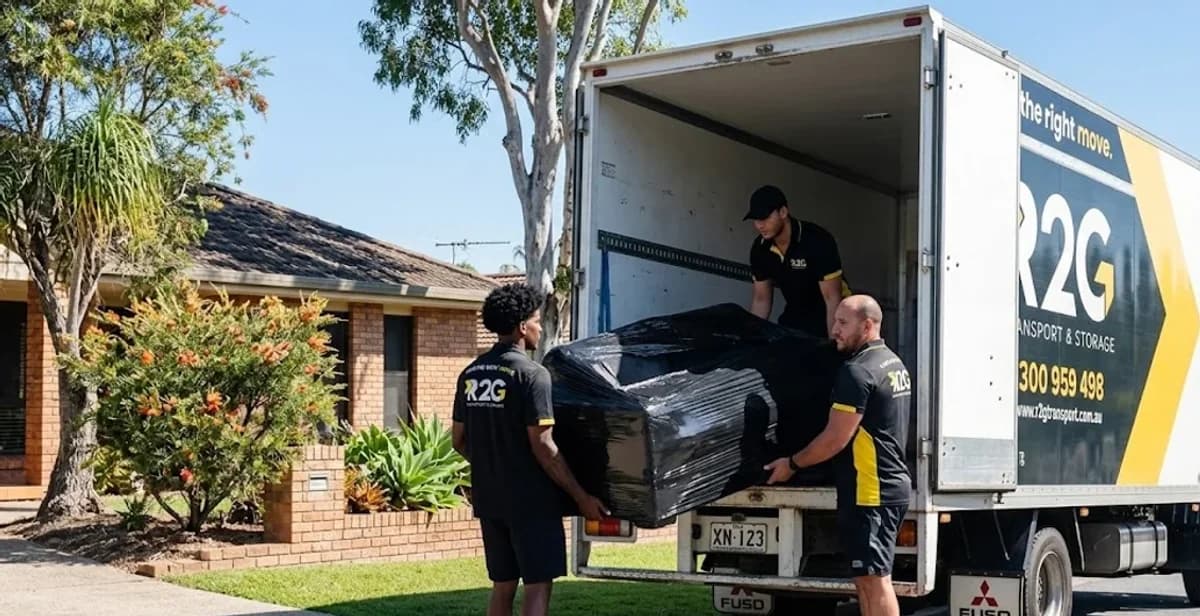
Our Brisbane depot is at 122 Ashover Circuit, Archerfield. People assume the hourly clock starts when the truck leaves that yard. That is not what our terms say.
For local moves, the hourly rate is charged in 15-minute increments. It starts when the crew arrives on site and stops when the move is finished at the final address. The drive from your old address to your new one sits inside that window, so it is on the clock.
Travel to the job and back is handled separately. The terms say a call-out fee is charged to cover travel expenses to and from the move, and that this fee is quoted before the move. It is not a number made up after the truck is back at Archerfield.
A fixed price, when we agree one, is calculated from your inventory before the day. Read that quote the same way: if travel is included, it should say so.
We are not going to invent a travel rate for this article. Distance, access and the shape of the job change it. The quote is where the figure belongs. If you want the wider picture of what else shapes a Brisbane price, that sits on our Brisbane removalist costs page.
What changes the travel component around Brisbane
Distance from Archerfield is the obvious one. A pickup in the southern suburbs is a shorter run from the depot than a pickup at Redcliffe or up the northside. The loaded run between homes is separate again. Our costs page uses a move from Redcliffe to Logan as the plain example: the addresses are far enough apart that travel time between them is a real part of the job, not a few minutes across one suburb.
Access does not change the depot run, but it changes how long the clock runs once the crew is there. Stairs, a lift that has to be booked, a long walk from where the truck can legally stop: all of that is time. Our terms put parking on you. You need a legal park or a loading zone for the truck. If the crew is hunting for a spot, or the building will not let the truck in, the job runs longer. Sort the park and the lift booking before the day, not when the truck is already on the street.
Two addresses are the normal house move. A third stop adds another leg. Storage is the common one. If the load comes back to our Archerfield store because settlement dates do not line up, that is an extra trip, not a free detour. The terms say that where goods go into storage, the removal is charged for the time and the travel fee involved, unless something else was arranged. If that is your situation, say so when you book, and read our Brisbane storage page so the gap between homes is planned rather than improvised.
The day can change the rate, which is not the same thing as changing the travel rule. Weekdays are the most affordable on our costs page, with slightly higher rates on weekends and public holidays. Ask whether an early start or a late finish changes the travel line. Do not guess that it does, and do not guess that it does not.
Tolls are the other quiet one. If the sensible route between your two addresses uses a toll road, ask who pays. Get the answer on the quote.
What to check on the quote before you book
Line the quotes up on the travel rule, not on the headline rate. A lower hourly rate with a depot-to-depot clock can cost more than a higher rate that starts at your door.
- Where the hourly clock starts and stops
- Whether travel to the job is charged, and whether the return to the depot is charged
- Whether that travel is time, a flat call-out, or inside a fixed figure
- The minimum hours, and whether travel sits inside the minimum or on top of it
- Billing increments after the minimum (ours are 15 minutes on local hourly work)
- What happens if the load is bigger than the inventory
- Who pays tolls
- Any separate fee for a storage drop
If a line is missing, ask. A company that cannot explain its own travel rule before you book is the one that will explain it on the invoice. Our notes on hidden fees on a removalist quote cover the other lines worth reading at the same time. This one is only the travel line.
What to ask before you book
- Does the clock start at the depot, or when you arrive at my address?
- Is the trip back to the depot charged, and is it time or a set fee?
- Is the drive between my two addresses inside the hourly time?
- What is the minimum, and does travel count towards it?
- If I am on a fixed price, is every travel leg inside that price?
- If the goods go into storage for a few days, how is that extra leg charged?
- If I am not ready when you arrive, does the clock still run?
Write the answers into the quote. A phone answer that never makes it onto the booking confirmation is not much use if the bill looks different.
Accreditation is a separate question from the travel line. AFRA's member page says members carry public liability insurance, and that goods-in-transit cover is usually something you arrange on top. Neither of those tells you whether the depot run is on the clock.
You also have ordinary consumer rights around the service itself. The ACCC's consumer guarantees say a service must be provided with due care and skill, be fit for the purpose you made known, and be supplied in a reasonable time if no time was agreed. Queensland's consumer guarantees for services say the same three things for services bought in this state. Those guarantees are about the work being done properly. They are not a substitute for reading the travel line. If the quote is clear and the invoice does not match it, that is a dispute about what was agreed. Start with the company, in writing.
A plain close
Removalists in Brisbane do charge for travel, in one form or another. On an hourly job, expect to pay for the loaded run between your two addresses, and check both empty ends separately. On a fixed job, expect the travel to be inside the price, and still make them say so.
On an R2G local job, the hourly rate in our terms runs from arrival on site to the end of the move at the last address, with a 2-hour minimum and 15-minute increments. The call-out that covers travel to and from the job is quoted before the day. If your quote does not show that clearly, ask before you book. Tell us both addresses, the access, and whether storage is involved, and we will put it in writing. Start with a free quote, or talk to our Brisbane removalists team if you want to walk the job through first.